The hidden cost of managing Oracle users one database at a time
Every new database adds another layer of user administration, password management, access reviews, and audit preparation. What starts as a manageable process quickly becomes an operational burden as your Oracle environment grows.
Oracle Centrally Managed Users (CMU) centralizes authentication through Microsoft Active Directory, helping eliminate much of that manual work. The challenge is that a successful CMU deployment depends on the decisions you make before implementation begins. Getting the architecture, schema strategy, and role mapping right from the start can save weeks of rework later.
But implementing CMU is about more than configuration. Decisions made before deployment—such as your Active Directory structure, schema strategy, and role mapping—have a lasting impact on security, scalability, and ongoing administration.
These challenges become more difficult with every Oracle database you add.
1
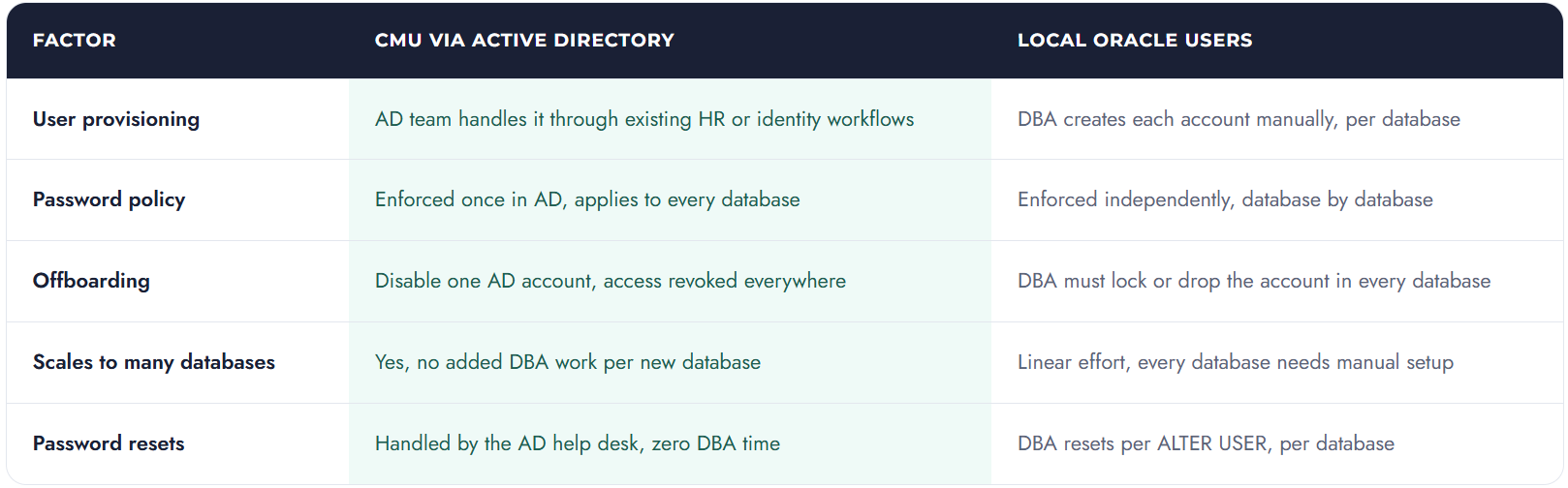
DBAs spend too much time managing users
Every Oracle database has its own users and passwords. Routine account management, password resets, and access requests quickly become a growing administrative burden.
2
User access becomes harder to manage
Creating, updating, and removing users across multiple databases increases complexity and the risk of inconsistent access.
3
Security policies become difficult to enforce
Different databases often end up with different password policies and authentication settings, creating unnecessary security risks.
4
Audit preparation takes longer
Tracking user access across multiple databases requires manual effort, making audits more time-consuming and difficult to manage.
Successful CMU deployments start with architecture, not installation.
Oracle Centrally Managed Users can simplify authentication and user management across your Oracle environment—but the quality of the implementation determines the long-term results.
Before implementation begins, critical decisions around schema strategy, Active Directory design, role mapping, and security policies shape how secure, scalable, and maintainable your environment will be for years to come.
Getting those decisions right early is what separates a smooth rollout from months of unnecessary rework.
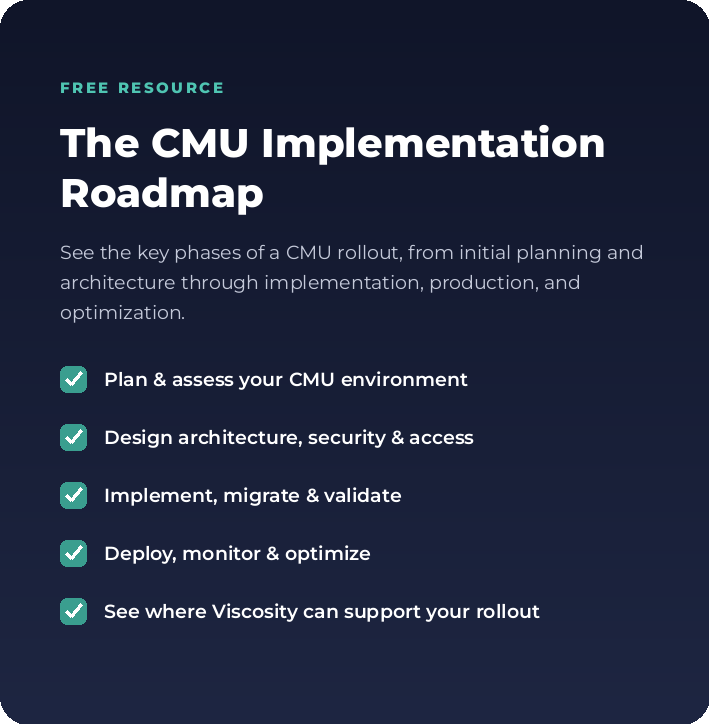
The CMU Implementation Roadmap gives you a clear view of what to plan before deployment begins.
Curious how Oracle Centrally Managed Users works in the real world? Watch this quick tip from Oracle ACE Director Gary Gordhamer, then contact our team to discuss your CMU implementation.
From Local Oracle Users to Centralized Identity Management
Oracle CMU separates identity management from database administration. Instead of creating and maintaining users in every Oracle database, authentication is centralized through Active Directory while Oracle continues to manage authorization through schemas and roles.
With authentication handled centrally, Oracle administrators can focus on managing database access—not user accounts.
Shared or Exclusive Schemas: Choose a shared schema for simplified administration or exclusive schemas where application or security requirements demand isolation.
Global Roles: Assign Oracle roles through Active Directory groups, reducing duplicated administration across databases.
Administrative Access: Manage SYSDBA and other privileged accounts through dedicated Active Directory groups for more consistent security and governance.
How Oracle CMU Authentication Works
The benefits of Oracle CMU are clear. The success of the deployment depends on the implementation.
Oracle CMU provides the framework for centralized identity management, but every Oracle environment is different. Decisions around schema strategy, Active Directory design, role mapping, and deployment planning determine whether your implementation remains secure, scalable, and easy to manage over time.
Four Steps to a Successful Oracle CMU Deployment
Every Oracle environment is unique. That's why successful Oracle CMU deployments begin with architecture and planning before moving into Active Directory configuration, Oracle integration, testing, and production rollout.
Architecture and prerequisites
Confirm your Oracle version, plan schema strategy, and align your DBA and AD teams before writing any SQL.
Active Directory configuration
Extend AD with the Oracle passeword hash utility and stand up the read-only service account CMY relies on.
Connect Oracle to AD
Build the wallet, directory object, and dsi.ora configuration, then verify Oracle can query AD directly.
Schema, roles, and go-live
Creat global schemas and roles, test authentication end to end, andget sign-off from every stakeholder.
The gap between "CMU is possible" and "CMU is production-ready" is where projects stall
The Oracle documentation tells you CMU exists. It doesn't tell you how your specific schema strategy, AD structure, and legacy accounts should come together without an outage.
Oracle documentation explains how CMU works. It doesn't tell you how to design the right schema strategy, structure Active Directory groups, migrate existing users, or validate a production rollout.
Those early implementation decisions determine whether your Oracle CMU deployment remains secure, scalable, and easy to manage. Or whether it becomes another project requiring ongoing rework.
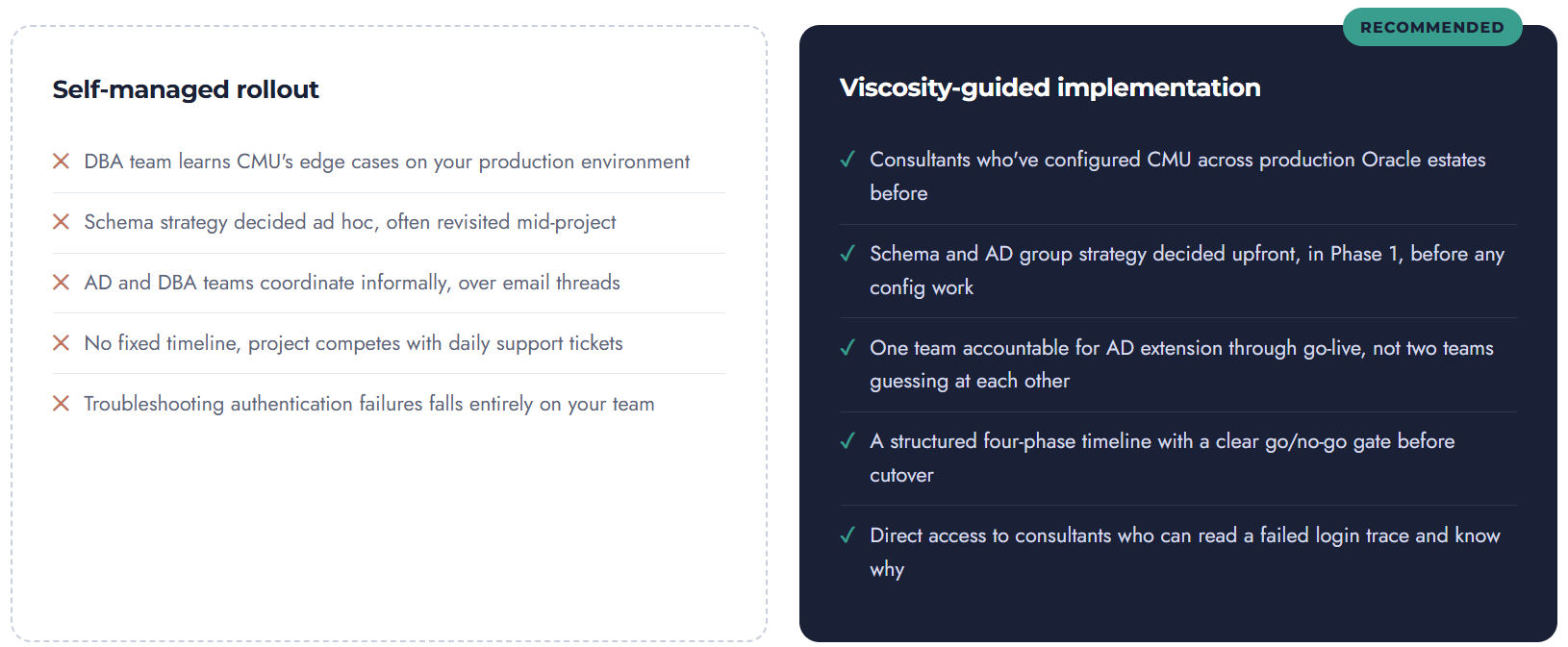
Managing CMU In-House vs Implementation with Viscosity


.png?width=1800&height=1040&name=CMU_login_banner_viscosity%20(3).png "CMU_login_banner_viscosity (3)")